
Inside Meydan: What Makes Dubai World Cup Day One of the Most Spectacular Racing Events in the World
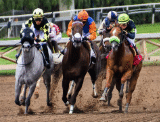 There is a moment at Meydan Racecourse when the atmosphere changes.
Conversations become shorter. Cameras rise. Jockeys settle into their saddles. Trainers take one last look at horses they have prepared for months, and thousands of spectators turn towards the track.
For a few minutes, the spectacular architecture, elegant hospitality areas and Dubai skyline seem almost secondary.
What remains is the reason everyone has come: some of the world’s finest racehorses preparing to compete on one of international racing’s biggest stages.
This is Dubai World Cup Day.
It is part elite sporting competition, part international meeting place and part major social occasion. At Meydan, horses and racing professionals from different continents come together with visitors who may have travelled thousands of kilometres to experience the event.
Some spectators know every horse’s pedigree, previous form and preferred racing surface. Others are attending a major race meeting for the first time.
But when the horses accelerate towards the finishing line, expertise is no longer required to understand the excitement.
Speed, uncertainty and competition tell the story.
For anyone interested in horse racing in Dubai, the Dubai World Cup provides a remarkable window into how the city transformed itself into one of the international meeting points of the sport.
Inside Meydan – More Than Just Another Day at the Races
Meydan Racecourse is difficult to understand simply through statistics.
The numbers are impressive, of course. The enormous grandstand stretches along the racecourse and can accommodate tens of thousands of spectators. The venue includes dirt and turf racing surfaces, extensive hospitality facilities and the infrastructure necessary to receive horses and racing teams arriving from around the world.
But scale alone does not explain Meydan.
What makes the racecourse unusual is the combination of very different worlds within one venue.
At ground level, everything revolves around horses.
Stable staff work behind the scenes. Trainers monitor their runners. Jockeys prepare mentally and physically. Veterinarians, farriers and other specialists perform jobs most spectators will never see.
Elsewhere, visitors arrive dressed for one of Dubai’s major social events. Restaurants and hospitality areas fill. International racing media prepare for broadcasts. Photographers search for images that capture both the sporting intensity and the glamour surrounding it.
And then there are the horses themselves.
They are the point at which all of these worlds meet.
Morning at Meydan – Before the Spectacle Begins
Long before the grandstand fills with spectators, the most important participants in Dubai World Cup Day are already being prepared.
A racehorse does not simply arrive at Meydan shortly before its race.
For international runners in particular, the journey may have begun days earlier and thousands of kilometres away.
Transporting an elite racehorse internationally requires careful planning. Travel arrangements, quarantine requirements, feeding, exercise and veterinary supervision all have to be coordinated.
The horse then needs time to become accustomed to its surroundings.
This hidden side of international racing is easy to overlook when watching the final race on television.
The public sees a horse for several minutes.
The team surrounding that horse may have spent months preparing for those minutes.
Dubai World Cup morning is therefore not simply the beginning of a sporting event. For trainers, stable staff and owners, it is the final stage of a much longer journey.
The International Horses Arrive in Dubai
One of the defining characteristics of the Dubai World Cup is its international character.
Horses can arrive from Europe, North America, Japan and other parts of the Middle East and Asia.
Each racing region brings different traditions.
European horses frequently develop within a racing culture dominated by turf.
North American racing has a particularly strong dirt tradition.
Japan has developed into one of the world’s most powerful thoroughbred racing and breeding nations.
UAE-based horses bring familiarity with Meydan and the local environment.
Dubai puts these different racing worlds onto the same stage.
That is one of the reasons the event can produce such fascinating contests.
Reputation matters before a race.
Once the starting gates open, it does not.
Why Meydan Is Built for International Racing
Meydan’s racing infrastructure helps make this international competition possible.
The racecourse offers both dirt and turf surfaces, allowing the Dubai World Cup meeting to stage races suited to different types of elite thoroughbred.
The headline Dubai World Cup is run over 2,000 metres on dirt.
Other major contests, including the Dubai Turf and Dubai Sheema Classic, take place on grass.
Sprinters, middle-distance horses and stayers can therefore appear during the same meeting.
Three-year-old thoroughbreds have the UAE Derby.
Purebred Arabian horses have the Dubai Kahayla Classic.
The result is not simply a famous final race.
It is an entire international racing programme.
The Paddock – Where the Horses Become the Stars
For many racing enthusiasts, one of the most fascinating moments comes before the race itself.
The paddock gives spectators an opportunity to see the horses away from the speed and intensity of competition.
This is where knowledgeable observers look closely.
Does a horse appear calm?
Is it alert?
How is it moving?
Does it seem comfortable with the atmosphere?
There is an almost theatrical quality to the moment, but for the people closest to the horse it is anything but theatre.
The trainer has done the work.
The stable staff have prepared the horse.
The jockey is about to take responsibility for what happens on the track.
And the horse has no understanding of the millions of dollars, international attention or sporting history surrounding the event.
It simply knows that it is about to race.
The Jockeys – A Few Minutes to Get Everything Right
Few professions in sport combine preparation and improvisation quite like that of a jockey.
Before a major race, there is a plan.
Everyone knows the horse’s strengths.
They know the opposition.
They know approximately where they would like to be positioned.
Then the gates open.
Plans can disappear within seconds.
A horse breaks slowly.
Another moves unexpectedly across the track.
A gap closes.
The pace becomes faster or slower than anticipated.
The jockey must respond while travelling at racing speed and surrounded by other horses doing exactly the same thing.
The difference between victory and defeat can be remarkably small.
Dubai racing history contains one of the best possible examples.
In 2019, Thunder Snow defeated Gronkowski in the Dubai World Cup by a nose.
Months of preparation came down to centimetres.
When Meydan Starts to Fill
As race time approaches, another transformation takes place.
Meydan stops feeling primarily like an enormous building and begins to feel like an event.
Spectators arrive.
Hospitality areas become busier.
Racing enthusiasts study the programme and discuss the horses.
Visitors take photographs.
International media begin reporting to audiences far beyond Dubai.
The languages heard around the racecourse reflect the international nature of the meeting.
A racing fan from Britain may be following a familiar European horse.
A Japanese visitor may have travelled specifically to see a runner from home.
American racing followers may be concentrating on the dirt races.
Local spectators have their own favourites.
For a few hours, Meydan becomes a small global village built around horse racing.
Nine Races – Nine Different Stories
Visitors unfamiliar with the event sometimes assume that Dubai World Cup Day revolves around one race.
It does not.
The World Cup is the climax, but the full meeting consists of nine high-level races.
Each has its own character.
The Dubai Kahayla Classic celebrates Purebred Arabian racing.
The Godolphin Mile provides a major dirt contest.
The Dubai Gold Cup rewards stamina over a longer distance.
The Al Quoz Sprint is about speed on turf.
The UAE Derby introduces some of the most promising three-year-old thoroughbreds.
The Dubai Golden Shaheen showcases high-class dirt sprinters.
The Dubai Turf and Dubai Sheema Classic attract leading international turf horses.
Finally comes the Dubai World Cup.
Rather than waiting all day for a single important race, spectators watch the international racing picture change repeatedly as different specialists take centre stage.
UAE Derby – A Glimpse of Tomorrow’s Champions
The Derby Dubai, officially known as the UAE Derby, occupies a particularly interesting position on the programme.
Unlike the Dubai World Cup, which attracts established older stars, the UAE Derby is for three-year-old thoroughbreds.
These are young horses whose full potential may still be unknown.
That creates a different type of excitement.
Watching an established champion is about seeing greatness confirmed.
Watching a young horse is about wondering what might happen next.
Could the winner become a future international champion?
Could this be the beginning of a career people will talk about years later?
Thunder Snow provides a remarkable example.
He won the UAE Derby in 2017.
One year later he won the Dubai World Cup.
In 2019 he won it again.
A horse seen as a developing three-year-old became the first dual winner of Dubai’s greatest race.
Dubai, Kentucky and an Increasingly Connected Racing World
The UAE Derby also forms part of a much larger international picture.
Dubai has strengthened its connection with the Road to the Kentucky Derby, creating opportunities for horses racing in the UAE to earn qualifying points towards the famous American Classic.
This would once have seemed an extraordinary racing journey.
Today it is entirely conceivable that a three-year-old could race in Dubai before travelling to the United States to pursue another major target.
Japan’s Forever Young demonstrated the growing importance of this international route after winning the UAE Derby in 2024 and subsequently competing at the highest level in the United States.
The modern racehorse can be an international athlete in the truest sense.
Dubai increasingly sits at the centre of those global routes.
Purebred Arabian Racing – A Link to the Region’s Heritage
Amid the international Thoroughbreds, another racing tradition remains important.
Purebred Arabian racing has a prominent place on Dubai World Cup Day through the Dubai Kahayla Classic.
The distinction matters.
The Dubai World Cup and UAE Derby are Thoroughbred races.
The Dubai Kahayla Classic is for Purebred Arabians.
This allows modern international racing and the region’s much older relationship with Arabian horses to share the same major stage without being confused with each other.
For visitors unfamiliar with racing in the UAE, understanding this distinction adds another layer to the Meydan experience.
Fashion at the Dubai World Cup
Then there is another competition entirely – although this one does not take place on the racetrack.
Fashion has become part of the identity of Dubai World Cup Day.
Visitors plan outfits well in advance.
Hats and headpieces can become elaborate statements in their own right.
The visual contrast is striking.
On one side is a sport built around speed, physical power and split-second decisions.
On the other is an audience for whom elegance and presentation have become part of the occasion.
This combination is not unique to Dubai.
Major racing events such as Royal Ascot, the Kentucky Derby and Melbourne Cup have long developed social traditions beyond the track.
Dubai has created its own interpretation – one that reflects the city’s international and highly visual character.
Hospitality – Another Side of the Meydan Experience
Meydan can be experienced in very different ways depending on where a visitor chooses to spend the day.
Some spectators primarily want a view of the racing.
Others combine the event with dining and hospitality.
At the premium end, Dubai World Cup Day offers elaborate hospitality experiences that turn the meeting into an all-day occasion.
Food, lounges and track views become part of the experience.
For corporate guests and international visitors, the social setting may be almost as important as the racing itself.
But regardless of how luxurious the surroundings become, the attention repeatedly returns to the same place.
The track.
When an important race starts, conversations stop.
The International Crowd – Dubai in Miniature
Perhaps nothing represents modern Dubai better than the crowd at a major international event.
The city itself is extraordinarily international, and Meydan reflects that character.
Owners, trainers, jockeys, journalists and spectators arrive from many countries.
Some come because they work in racing.
Some travel specifically for the Dubai World Cup.
Others are tourists who have added the race meeting to a wider Dubai trip.
This creates an atmosphere very different from a purely domestic sporting event.
When a Japanese horse wins, one section of the crowd may erupt.
A European-trained runner may have another group of supporters.
UAE-based horses naturally generate local interest.
The competition is international, but so is the audience.
Japan – A New Power at Meydan
The rise of Japanese racing has become one of the most interesting developments in modern international horse racing.
Japan is no longer simply sending horses abroad to participate.
Its best runners arrive capable of winning the biggest races.
Meydan has provided an important stage for that development.
Japanese horses have achieved major Dubai victories and increasingly arrive with considerable expectations.
This has changed the balance of international meetings.
Older narratives often presented global racing as primarily a contest between Europe and North America.
That description is no longer sufficient.
Japan must be part of the conversation.
And Dubai is one of the places where these different racing powers regularly meet.
The Trainers – Months of Work Hidden Behind Two Minutes
Racehorses may receive the applause, but trainers carry a different kind of pressure.
Their job is not simply to make a horse fast.
They have to decide when it should race, how hard it should train, when it needs recovery and whether a particular international target is realistic.
For a horse travelling to Dubai, those decisions become even more complex.
Climate, transport, quarantine and unfamiliar surroundings all have to be considered.
A trainer can prepare perfectly and still lose.
That is the nature of racing.
Another horse may simply be better on the day.
A difficult start can change everything.
The pace can develop unexpectedly.
Traffic can become a problem.
This uncertainty is precisely what prevents major races from becoming predictable demonstrations of reputation.
The favourite still has to run.
The Stable Staff – Racing’s Essential People Away From the Cameras
Behind every famous trainer and jockey are people whose names most spectators will never know.
Stable staff spend far more time with the horses than the public figures associated with them.
They feed them, walk them, groom them, observe their behaviour and notice subtle changes.
Exercise riders learn how a horse feels during training.
Farriers care for its feet.
Veterinarians monitor health.
International transport teams make sure the horse can travel safely.
Without these people, there is no Dubai World Cup.
The polished spectacle seen by spectators is built on thousands of routine tasks performed when nobody is watching.
Minutes Before the Dubai World Cup
As the final major race approaches, the atmosphere at Meydan changes again.
By now the audience has already watched hours of racing.
Champions have been crowned.
Some favourites have won.
Others have disappointed.
Young horses have offered glimpses of their future.
International rivalries have played out on dirt and turf.
But the biggest question remains unanswered.
Who will win the Dubai World Cup?
The horses appear.
The jockeys are mounted.
Names that have been discussed for weeks suddenly become living animals walking in front of the crowd.
Predictions no longer matter.
The race is about to provide the answer.
When the Starting Gates Close
There is something strangely final about the sound of a starting gate closing behind a racehorse.
Until that moment, almost everything has been preparation.
Breeding.
Training.
Travel.
Race planning.
Tactics.
Media speculation.
Once the gates open, none of it can be changed.
The horses accelerate.
Jockeys search for position.
The field begins to take shape.
For spectators, the race may last only a couple of minutes.
For the people who have prepared a horse for months, those minutes can feel very different.
The Meydan Home Straight
The final straight is where the Dubai World Cup becomes most dramatic.
Horses that appeared comfortable can suddenly weaken.
Others begin to accelerate.
A jockey searches for an opening.
A leader attempts to hold on.
The noise from the crowd increases as the distance to the winning post disappears.
Sometimes one horse dominates.
Sometimes several arrive almost together.
And occasionally Meydan produces a finish that becomes part of racing history.
Thunder Snow vs. Gronkowski – When Centimetres Made History
The 2019 Dubai World Cup remains the perfect example.
Thunder Snow entered as defending champion.
Victory would make him the first horse to win the race twice.
Gronkowski had other ideas.
In the closing stages the two fought towards the line with almost nothing separating them.
Thunder Snow prevailed by a nose.
For jockey Christophe Soumillon, trainer Saeed bin Suroor, Godolphin and everyone involved with the horse, the margin was enough.
A few centimetres transformed Thunder Snow from defending champion into a unique figure in Dubai World Cup history.
The full story of Dubai Derby 2019 demonstrates why the outcome of an elite race can remain memorable years after the crowd has left the grandstand.
Arrogate – When a Race Appeared Lost Before It Had Begun
Another unforgettable Meydan performance came in 2017.
Arrogate entered the Dubai World Cup as one of the most celebrated horses in international racing.
Then the start went badly.
He found himself behind the field, and for a horse expected to win, the situation looked disastrous.
What followed became one of the great Dubai World Cup performances.
Arrogate recovered.
He moved through the field.
And he won.
The performance demonstrated another fundamental truth about racing.
Nothing is guaranteed.
Even the best horse can face adversity.
What happens next reveals why champions become champions.
The Winner Crosses the Line – Then Everything Changes
Victory creates an immediate transformation.
Seconds earlier, several horses still had a chance.
Then one crosses the line first.
For the winning connections, months or even years of work suddenly have a result attached to them.
For the jockey, there is the immediate emotion of knowing the decision-making worked.
For the trainer, the preparation has been vindicated.
For owners and breeders, the horse’s record has changed permanently.
And for the horse itself?
The celebrations are a human invention.
Its job is finished.
Magnitude and the 30th Dubai World Cup
In 2026, the Dubai World Cup reached another milestone with its 30th running.
The US$12 million feature race produced another international contest, with Magnitude defeating Japanese star Forever Young.
The wider meeting again demonstrated the depth of international racing at Meydan.
Calandagan captured the Dubai Sheema Classic, while Ombudsman won the Dubai Turf.
The anniversary was significant because it illustrated just how quickly the Dubai World Cup had become an established part of international racing.
Thirty editions are enough to create generations of memories.
Cigar.
Dubai Millennium.
Arrogate.
Thunder Snow.
Ushba Tesoro.
Laurel River.
Magnitude.
Different eras, different horses – the same finishing line at the centre of Dubai’s biggest racing occasion.
From Meydan to Millions of Viewers Around the World
The crowd inside Meydan represents only part of the Dubai World Cup audience.
The event is now distributed internationally through broadcasters and digital platforms.
This global reach is crucial.
An international race needs an international audience.
Supporters in Japan can follow Japanese runners.
European racing enthusiasts can watch familiar horses compete under completely different conditions.
American viewers can follow leading dirt performers.
Dubai becomes the physical meeting point while television and digital media extend the event far beyond the UAE.
The result is a race day that takes place at Meydan but belongs to a much larger international racing community.
Dubai World Cup Day and the City Around It
The location also matters.
The Dubai World Cup does not take place in isolation from its host city.
International visitors can combine the meeting with everything else Dubai offers.
Hotels, restaurants, beaches, desert experiences, shopping and major attractions make it possible to build an entire trip around race day.
This gives Dubai an advantage over racing destinations where the event itself may be the principal attraction.
Someone travelling primarily for horse racing can also experience Dubai.
Someone already visiting Dubai can discover horse racing.
The audiences overlap.
Is Dubai World Cup Day Only for Racing Experts?
No.
Understanding horse racing certainly adds depth to the experience, but it is not a requirement.
A newcomer may not understand every racing abbreviation or know the pedigree of every runner.
That does not prevent someone from appreciating what is happening.
The horses themselves provide the spectacle.
The programme gives structure to the day.
The crowd provides atmosphere.
Meydan provides the setting.
And major races provide stories that can be understood immediately: favourites against outsiders, champions against challengers, young horses against expectations and international rivals meeting for the first time.
Many lifelong racing enthusiasts discovered the sport because they attended one race meeting without initially knowing very much about it.
What Should First-Time Visitors Know?
A little preparation can make a first visit more enjoyable.
Visitors should check the current race-day schedule, ticket categories and admission conditions before travelling to Meydan.
Dress expectations can vary according to the enclosure or hospitality area, so these should also be checked in advance.
Arriving with enough time to explore the venue before the major races is worthwhile.
It allows visitors to understand the layout, watch the horses before racing and experience how the atmosphere develops during the day.
Most importantly, first-time visitors should not feel they need to understand everything.
Watch the horses.
Watch the people working with them.
Listen to the crowd as the field enters the straight.
The sport explains itself remarkably well once the race begins.
Why Dubai World Cup Day Is More Than a Horse Race
Calling the Dubai World Cup simply a horse race is technically correct.
But it misses most of the story.
The event is the visible result of an international racing system involving breeders, owners, trainers, jockeys, stable staff, veterinarians, race organisers, broadcasters and thousands of other people.
It brings different racing cultures together.
It connects Purebred Arabian racing with a modern international Thoroughbred programme.
It links Dubai with Kentucky, Japan, Europe and other major racing regions.
It combines elite sport with tourism, hospitality, fashion and entertainment.
And every year it creates something that cannot be planned in advance:
A result.
Inside Meydan – Where the Spectacle Ultimately Comes Back to the Horse
Meydan can impress through sheer scale.
The prize money can attract headlines.
Fashion can fill photographs.
Hospitality can turn race day into a luxury experience.
Dubai itself provides a spectacular international backdrop.
Yet none of these things explains why spectators suddenly become quiet when the horses approach the starting gates.
At that moment, everything returns to something remarkably simple.
A group of horses.
A racetrack.
A finishing line.
And nobody knows for certain which horse will reach it first.
That uncertainty has fascinated people for generations.
Dubai has simply given it one of the world’s most spectacular stages.
From the young Thoroughbreds competing in the Derby Dubai to the international champions contesting the Dubai World Cup, Meydan brings together almost every element that makes modern horse racing fascinating.
History is present through the champions whose names are already remembered.
The future appears in young horses whose greatest races may still lie ahead.
And somewhere between the two is the race taking place right now.
That is what it feels like to be inside Meydan on Dubai World Cup Day.
Before the race, everyone has an opinion.
After the race, there is a story.
Tagged With : Inside Meydan • Inside Meydan: What Makes Dubai World Cup Day One of the Most Spectacular Racing Events in the World There is a moment at Meydan Racecourse when the atmosphere changes.