
History of Horse Racing in Dubai – From Arabian Horses to Meydan and the Dubai World Cup
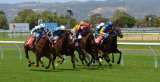 Long before the floodlights of Meydan Racecourse illuminated some of the finest thoroughbreds on the planet, horses were already deeply woven into the history of the Arabian Peninsula.
For generations, they represented endurance, mobility, prestige and a close relationship between people and animals in a demanding environment. The Arabian horse became admired far beyond the Middle East, eventually influencing breeding programmes and equestrian traditions around the world.
Modern Dubai could hardly look more different from the landscapes in which these traditions developed. Skyscrapers now dominate the skyline, millions of international visitors arrive every year, and the city has become synonymous with ambitious architecture, tourism and global business.
Yet horses have never disappeared from the story.
Instead, Dubai took an old equestrian tradition and transformed it into something new: a modern international racing industry capable of bringing leading horses, jockeys, trainers and owners from Europe, Asia, North America and the Middle East together in one place.
At the centre of that transformation today stands Meydan Racecourse and the Dubai World Cup.
But neither appeared overnight.
The story of horse racing in Dubai is one of extraordinary development – from modest early race meetings to a sporting event watched by racing enthusiasts around the world.
The Arabian Horse – Where Dubai’s Equestrian Story Begins
Any history of horse racing in Dubai should begin long before the first modern racecourse was built.
Horses have occupied an important place in Arabian culture for centuries.
The Arabian horse became particularly celebrated for its endurance, intelligence, adaptability and distinctive appearance. Developed in the challenging environment of the Arabian Peninsula, the breed acquired an international reputation that eventually extended far beyond its region of origin.
Arabian bloodlines also contributed to the development of other breeds.
This historical connection helps explain why equestrian sport carries a cultural significance in the UAE that extends beyond modern racing.
However, an important distinction needs to be made.
The famous races held at Meydan today are not all races for Arabian horses.
The Dubai World Cup and UAE Derby, for example, are thoroughbred races. Purebred Arabian racing exists alongside international thoroughbred racing and has its own prestigious competitions.
This distinction between Arabian horses and Thoroughbreds is fundamental to understanding Dubai’s modern racing scene.
Horse Racing and Camel Racing – Two Different Traditions
Another distinction is equally important.
Horse racing and camel racing both have deep connections with the heritage of the UAE, but they are separate sports.
Older descriptions of racing in Dubai sometimes mix the two together, particularly when discussing the history of racing traditions in the region.
Modern horse racing in Dubai, however, has its own racecourses, rules, horses and international competitions.
The Dubai World Cup is a horse race.
The UAE Derby is a horse race.
Camel racing takes place separately at dedicated venues.
Both traditions form part of the wider sporting heritage of the Emirates, but understanding the difference is essential when exploring the development of Dubai as an international horse racing centre.
1981 – The Beginning of Modern Thoroughbred Racing in Dubai
The transformation from traditional equestrian culture to organised international thoroughbred racing began modestly.
In October 1981, Dubai hosted its first thoroughbred race meeting.
The location was not Meydan. It was not even the later Nad Al Sheba Racecourse that would become famous as the original home of the Dubai World Cup.
The meeting took place at the Camel Track.
Three thoroughbred races were staged.
Looking back from the enormous grandstands and international spectacle of modern Meydan, those beginnings seem remarkably small.
Yet they represented an important moment.
Dubai had begun building the foundations of what would eventually become a globally recognised racing industry.
Few spectators attending those early races could have imagined that, several decades later, horses from some of the world’s strongest racing nations would travel to Dubai to compete for millions of dollars in prize money.
1992 – The Dubai Racing Club Is Established
The next major step came in 1992 with the establishment of the Dubai Racing Club.
Organised racing needed more than horses and a track. It required administration, professional standards, race programmes and a long-term vision.
Dubai increasingly looked beyond purely local competition.
The ambition was international.
That direction became clearer almost immediately.
In 1993, Dubai staged the Dubai International Jockeys’ Challenge, bringing prominent riders from different parts of the racing world together.
The concept was revealing.
Rather than building a racing industry isolated from established centres such as Britain, Ireland, France, the United States or Japan, Dubai wanted to become a place where those racing cultures could meet.
That philosophy would eventually define the city’s greatest race.
The Idea That Changed Dubai Racing
By the early 1990s, Dubai’s ambitions in thoroughbred racing were becoming increasingly visible.
But creating another race meeting was one thing.
Creating a race capable of attracting the world’s attention was something entirely different.
To achieve that, Dubai needed a competition with sufficient prestige, prize money and international appeal to persuade elite horses to travel considerable distances to the UAE.
The result was the Dubai World Cup.
When the race was announced, the concept was bold: invite outstanding international thoroughbreds to Dubai and create a genuinely global competition.
The first running would demonstrate whether that vision could work.
It did.
1996 – Cigar and the First Dubai World Cup
On 27 March 1996, the first Dubai World Cup was staged at Nad Al Sheba Racecourse.
Among the horses arriving in Dubai was one whose reputation was already enormous.
His name was Cigar.
The American champion had established himself as one of the outstanding racehorses of his generation. His presence immediately gave the new Dubai event international credibility.
Cigar won.
It is difficult to imagine a more effective beginning for a race attempting to establish itself on the world stage.
Dubai had created a new international contest and its inaugural champion was already a racing superstar.
The victory meant that the Dubai World Cup did not have to spend years quietly building recognition. From its first edition, it had a winner that racing enthusiasts around the world knew.
A new chapter in Horse Racing Dubai had begun.
Why the Dubai World Cup Was Different
The idea behind the race was not simply to create another prestigious domestic competition.
Dubai wanted international confrontation.
Thoroughbred racing had traditionally been organised around powerful national and regional centres. Britain and Ireland had their classic traditions. France had some of Europe’s greatest races. North America had its dirt-racing culture and events such as the Kentucky Derby and Breeders’ Cup.
Japan was rapidly developing an increasingly powerful racing industry.
Dubai offered something different: a meeting point.
Its geographical position between Europe and Asia helped, but so did its willingness to attract international competitors with substantial prize money and first-class facilities.
The Dubai World Cup gradually became a race where champions from different racing environments could meet.
That remains one of its greatest attractions.
Dubai Millennium – A Name Written Into Racing History
If Cigar gave the Dubai World Cup international credibility, another horse would soon give the race one of its defining performances.
Dubai Millennium entered the 2000 Dubai World Cup carrying enormous expectations.
He delivered.
His victory became one of the most celebrated moments in the early history of the event and permanently connected his name with Dubai’s racing ambitions.
Dubai Millennium’s career was relatively short, but his influence extended far beyond his performances on the racecourse.
His legacy continued through breeding, helping establish a bloodline that would influence elite thoroughbred racing for years.
For Dubai, his World Cup victory represented something else as well.
The race was no longer simply a wealthy new competition attempting to attract attention.
It was beginning to create its own history.
Godolphin – Dubai Goes Global
No account of modern horse racing in Dubai would be complete without Godolphin.
The international thoroughbred racing and breeding operation became one of the most recognisable names in the sport.
Its royal-blue colours can be seen far beyond the UAE.
Godolphin horses have competed successfully at major meetings in Britain, Ireland, France, the United States, Australia, Japan and many other racing nations.
That global presence matters to the story of Dubai.
Instead of simply inviting the racing world to the UAE once a year, Dubai became part of international racing throughout the season.
Horses connected with Dubai competed at Ascot, Newmarket, Churchill Downs, Longchamp, Flemington and other famous venues.
The relationship became two-way.
International racing came to Dubai, and Dubai went out into international racing.
Nad Al Sheba – The Original Home of the Dubai World Cup
Before Meydan, there was Nad Al Sheba.
For many years, the racecourse was the physical centre of Dubai’s rapidly growing racing ambitions.
It hosted the first Dubai World Cup in 1996 and remained home to the event through 2009.
During those years, the reputation of the World Cup continued to grow.
More international horses arrived.
More champions emerged.
The racing industry surrounding Dubai became increasingly sophisticated.
Yet Dubai has rarely been a city satisfied with standing still.
By the 2000s, plans were developing for something considerably larger.
Nad Al Sheba had helped establish Dubai on the international racing map.
Its successor would be designed to make an entirely different statement.
2009 – The End of an Era
The 2009 Dubai World Cup represented the final edition staged at Nad Al Sheba.
For racing enthusiasts who had watched the development of the event since 1996, it marked the end of an important chapter.
The venue had witnessed the transformation of an ambitious new race into an established international competition.
But nearby, Dubai was preparing its next step.
A vast new racecourse was taking shape.
Its name was Meydan.
2010 – Meydan Changes the Scale of Horse Racing in Dubai
When Meydan Racecourse opened in 2010, Dubai’s ambitions were impossible to miss.
This was not simply a replacement racecourse.
Meydan was conceived as a major international sporting venue.
The enormous grandstand stretched across the complex, providing space for tens of thousands of spectators.
There were extensive hospitality facilities, restaurants and viewing areas.
Most importantly for the sport itself, Meydan offered world-class racing infrastructure.
The venue could stage both dirt and turf racing, allowing horses from different international racing traditions to compete in conditions suited to their specialities.
For Dubai, Meydan represented the physical expression of everything its racing industry had been building towards since the early 1980s.
The journey from three thoroughbred races at the Camel Track to Meydan had taken less than three decades.
Meydan Racecourse – More Than a Racetrack
Today, Meydan is inseparable from the international image of horse racing in Dubai.
On an ordinary racing day, it functions as a professional sporting venue.
On Dubai World Cup day, it becomes something considerably larger.
Horses, owners, trainers and jockeys arrive from different countries. International racing media follow the action. Visitors combine racing with hospitality and entertainment.
Fashion becomes part of the spectacle.
For tourists who may know Dubai primarily through the Burj Khalifa, beaches, hotels and shopping, Meydan reveals another side of the city.
The racecourse also demonstrates how Dubai approaches major sporting events.
Infrastructure is not treated merely as functional.
It becomes part of the experience.
Why Meydan Has Both Dirt and Turf Racing
The two racing surfaces at Meydan are particularly important to its international role.
Horse racing traditions differ considerably around the world.
Many of Europe’s most prestigious flat races take place on turf.
Dirt racing, by contrast, has historically played a particularly important role in North America.
Japan has developed elite competition across different conditions, while horses based in the Middle East may encounter both surfaces.
By staging major races on dirt and turf, Dubai can attract a broader range of international competitors.
The headline Dubai World Cup is contested over 2,000 metres on dirt.
Other major races on the same programme take place on turf.
This diversity is one reason Dubai World Cup day is much more than a single famous race.
Dubai World Cup Day – Nine Races, One International Stage
The Dubai World Cup naturally receives most of the attention, but the wider meeting is what turns the day into an international racing festival.
The programme includes races for different ages, distances, surfaces and racing specialities.
Among the most important are:
Dubai World Cup – the headline Group 1 race over 2,000 metres on dirt.
Dubai Sheema Classic – a prestigious international turf race.
Dubai Turf – another major Group 1 competition on grass.
Dubai Golden Shaheen – a leading dirt sprint.
Al Quoz Sprint – a high-level turf sprint.
Dubai Gold Cup – a test for horses capable of competing over longer distances.
Godolphin Mile – an important dirt contest.
UAE Derby – the major Dubai race for three-year-old thoroughbreds.
Dubai Kahayla Classic – an important event for Purebred Arabian horses.
Together, these races demonstrate the breadth of Dubai’s modern racing industry.
Derby Dubai – The UAE Derby and the Champions of Tomorrow
While the Dubai World Cup showcases established elite racehorses, the UAE Derby has a different purpose.
The Derby Dubai, officially known as the UAE Derby, is a Group 2 race for three-year-old thoroughbreds.
It is contested over 1,900 metres on dirt at Meydan.
The age restriction makes it particularly fascinating.
Three-year-old horses are still developing. Their full potential may not yet be known.
A horse can arrive in Dubai as a promising young runner and leave with an international reputation.
The UAE Derby has also acquired greater significance through its connection with the Road to the Kentucky Derby.
That creates an intriguing international pathway: a young horse can race in Dubai and potentially continue towards one of the most famous three-year-old races in the United States.
From Dubai to Kentucky
The connection between the UAE Derby and Kentucky illustrates just how global modern horse racing has become.
Once, national racing programmes were considerably more isolated.
Today, owners and trainers can plan campaigns spanning several continents.
A horse may begin its season in Asia, travel to Dubai, compete at Meydan and then continue to the United States.
The logistics are complex, and international travel places its own demands on horses and racing teams.
But the rewards can be significant.
For Dubai, this international mobility strengthens the importance of the UAE Derby beyond the Middle East.
It is not simply a prestigious race on Dubai World Cup day.
It can form part of a much larger international campaign.
Thunder Snow – From UAE Derby Winner to Dubai World Cup Legend
Few horses illustrate this progression better than Thunder Snow.
The Godolphin thoroughbred won the UAE Derby in 2017.
That alone was a significant achievement.
But his story at Meydan was only beginning.
One year later, Thunder Snow returned and won the Dubai World Cup.
Then came 2019.
He returned again as defending champion with an opportunity to achieve something unprecedented.
No horse had ever won consecutive editions of the Dubai World Cup.
Thunder Snow would have to make history to retain his title.
Dubai Derby 2019 – A Nose That Made History
The final stages of the 2019 Dubai World Cup produced one of the most dramatic moments Meydan had witnessed.
Thunder Snow and Gronkowski fought towards the finishing line with almost nothing separating them.
Christophe Soumillon was aboard Thunder Snow, who was trained by Saeed bin Suroor.
Gronkowski refused to disappear.
The two horses reached the line almost together.
Thunder Snow had won – by a nose.
The result made him the first horse in Dubai World Cup history to win the race in consecutive years.
For a detailed look back at the race, the story of Dubai Derby 2019 remains one of the most remarkable chapters in Meydan’s history.
Thunder Snow’s progression also demonstrates exactly why the UAE Derby and Dubai World Cup should not be confused.
He won the UAE Derby in 2017.
Then he won the Dubai World Cup in 2018 and 2019.
Two different races – one extraordinary career.
2020 – The Year the Dubai World Cup Stopped
After the drama of 2019 came a year unlike anything modern international sport had experienced.
The COVID-19 pandemic spread around the world in early 2020, disrupting sporting calendars on every continent.
Dubai was not immune.
The Dubai World Cup meeting scheduled for March 2020 was cancelled.
For an event that had become an annual fixture on the international racing calendar, the cancellation was extraordinary.
The story of Dubai horse racing 2020 therefore remains a historical exception.
What once looked like a defining crisis is now better understood as one unusual chapter in a much longer story.
Racing returned.
International horses returned.
Meydan again became a meeting point for the racing world.
The Return of International Racing
The years following the pandemic demonstrated the resilience of international horse racing.
Travel resumed, spectators returned and global competition rebuilt itself.
Dubai again attracted leading horses from different racing regions.
But something else had changed.
International racing was becoming even more global.
Japan in particular was emerging as an increasingly powerful force.
Japan’s Growing Influence at Meydan
For much of the twentieth century, discussions about elite international thoroughbred racing tended to focus heavily on Europe and North America.
That picture has changed.
Japan has developed one of the world’s strongest racing and breeding industries.
Japanese horses increasingly travel internationally and compete successfully against elite opposition.
Dubai has become an important stage for this development.
Japanese-trained runners have produced major performances at Meydan, demonstrating that the international balance of racing power continues to evolve.
The UAE Derby provides a particularly interesting example.
Crown Pride won the race in 2022.
Forever Young followed with another Japanese victory in 2024 before continuing his international campaign in the United States.
Such performances demonstrate why Dubai’s role as a meeting point has become increasingly valuable.
Europe, America, Japan and the Middle East Meet in Dubai
Few aspects of the Dubai World Cup meeting are more interesting than the diversity of racing backgrounds represented.
A British or Irish-trained horse may arrive after developing on turf.
An American horse may bring extensive dirt experience.
A Japanese runner can arrive from one of the world’s most competitive racing systems.
UAE-based horses have the advantage of familiarity with the local environment and Meydan.
The horses themselves must adapt, but so must their teams.
International travel, climate, training schedules and different racing conditions all influence preparation.
When the starting gates open, however, those differences disappear.
The horses compete on the same track.
That is international racing in its purest form.
Purebred Arabian Racing – The Other Side of Meydan
The rise of international thoroughbred racing has not eliminated the UAE’s connection with Arabian horses.
Purebred Arabian racing remains an important part of the region’s equestrian culture.
The Dubai Kahayla Classic provides a prestigious stage for Purebred Arabians during the Dubai World Cup programme.
This is significant.
Dubai has not simply imported an international thoroughbred racing model and forgotten its own equestrian heritage.
Instead, the two traditions exist alongside each other.
The Dubai World Cup and UAE Derby showcase Thoroughbreds.
The Dubai Kahayla Classic showcases Purebred Arabians.
Understanding that distinction provides a much more accurate picture of horse racing in the UAE.
The People Behind the Horses
A great racehorse may become famous, but no horse reaches an event such as the Dubai World Cup alone.
Behind every runner stands a team.
Trainers plan campaigns months in advance.
Exercise riders work with horses away from the public eye.
Stable staff provide daily care.
Veterinarians monitor health and fitness.
Farriers maintain the hooves on which every stride depends.
Transport teams organise complex international journeys.
And finally, when race day arrives, the jockey must make decisions at high speed while surrounded by rivals attempting to do exactly the same thing.
The glamour of Dubai World Cup day can sometimes obscure this enormous amount of work.
Yet the international quality of the event exists because thousands of hours of preparation take place before the horses ever reach the starting gate.
Jockeys – Decisions Made in Seconds
Jockeys occupy a particularly unusual position.
They are among the most visible people in racing, yet much of their work takes place in only a few minutes.
During a race, decisions must be almost instantaneous.
Should the horse move forward?
Wait?
Stay near the rail?
Move outside?
When should the final challenge begin?
A mistake lasting only a second can change the result.
Thunder Snow’s 2019 victory by a nose illustrates just how small the margins can become.
At the highest level of racing, centimetres can separate a place in history from second place.
Godolphin’s Global Connection
Godolphin remains one of the clearest examples of Dubai’s relationship with the wider racing world.
The operation does not treat Dubai as an isolated centre.
Its horses race internationally.
Its breeding programme operates across borders.
Its trainers, jockeys and staff form part of a global racing network.
This has helped make Dubai visible throughout the racing year rather than only during the World Cup meeting.
For enthusiasts watching major races in Europe, Australia, North America or elsewhere, Dubai’s influence can appear through the familiar blue Godolphin silks.
That international presence reinforces a simple point:
Dubai did not become important in horse racing simply by building a spectacular racecourse.
It became important by participating in the sport globally.
Fashion, Hospitality and the Social Side of Racing
Not everyone attending Meydan is a dedicated racing expert.
That has always been part of the attraction of major horse racing events.
Royal Ascot is famous for its social traditions.
The Kentucky Derby has its own distinctive culture.
Melbourne Cup day extends far beyond the race itself.
Dubai has developed its own version.
On Dubai World Cup day, fashion becomes highly visible. Elegant outfits and elaborate hats contribute to the atmosphere.
Hospitality plays another major role.
Restaurants, lounges and viewing areas allow visitors to experience the meeting in different ways.
For serious racing followers, all of this may remain secondary to the horses.
For other visitors, it is precisely the combination of sport and social occasion that makes the event attractive.
Both groups contribute to the character of the day.
Horse Racing as Part of Dubai Tourism
Dubai has become one of the world’s most recognisable tourism destinations.
The Burj Khalifa, Palm Jumeirah, Dubai Creek, beaches, desert experiences, hotels and shopping centres attract visitors with very different interests.
Horse racing adds another dimension.
For international racing enthusiasts, the Dubai World Cup can be the central reason for travelling.
For other tourists, a visit to Meydan can become one experience within a wider holiday.
This relationship between sport and tourism is important.
Major sporting events bring international visitors, media coverage and global attention to a destination.
Dubai has developed this strategy across numerous sports, including golf, tennis, motorsport and cricket.
Horse racing, however, has something those sports do not.
It connects modern Dubai directly with the equestrian heritage of the region.
What Is It Like to Visit Meydan Racecourse?
For someone attending for the first time, Meydan can feel very different from a traditional European racecourse.
The scale is immediately noticeable.
The grandstand dominates the venue, while the racing surfaces stretch out in front of the spectators.
On major race days, the crowd is international.
Languages from around the world can be heard as visitors, owners, racing professionals and media gather in the same venue.
The atmosphere changes throughout the programme.
Early races create anticipation.
Major international contests increase the intensity.
Then the Dubai World Cup brings the meeting to its climax.
For a first-time visitor, understanding every detail of form, breeding or racing tactics is not necessary.
The spectacle itself is accessible.
A field of elite thoroughbreds accelerating towards the Meydan finishing line requires little explanation.
When Is the Best Time to Experience Horse Racing in Dubai?
Dubai’s racing season is concentrated during the cooler months of the year.
This timing is practical for both horses and visitors and coincides with one of the most attractive periods for tourism in the UAE.
Race meetings build through the season towards the major international events.
For visitors whose primary goal is simply to experience racing at Meydan, regular meetings can offer an interesting introduction.
For those who want the largest possible spectacle, Dubai World Cup day is in a different category.
Because schedules, admission arrangements and hospitality options can change, visitors should always check current official information before planning a trip.
This is particularly important for international travellers organising flights and accommodation around a specific race meeting.
Can You Watch Dubai Horse Racing From Abroad?
Dubai’s racing audience extends far beyond Meydan.
Major races are followed internationally through television, racing broadcasters, digital platforms and specialist media.
This is essential to the global character of the event.
When a leading Japanese horse travels to Dubai, fans in Japan want to follow it.
The same applies to horses from Britain, Ireland, France, the United States and other racing nations.
Digital coverage has made these connections stronger.
Race results, interviews, analysis and video can travel around the world almost instantly.
A spectator no longer needs to be physically present in Dubai to follow the international competition at Meydan.
Why Dubai Matters to Global Horse Racing
Dubai’s importance cannot be explained by one factor.
Prize money matters.
Meydan matters.
Godolphin matters.
The Dubai World Cup matters.
But the larger achievement has been connecting these individual elements.
Dubai created an international race and attracted elite horses.
It built a modern racecourse capable of hosting them.
It developed a global racing operation that competes far beyond the UAE.
It established races for different types of horses and different surfaces.
And it turned the biggest meeting of the season into an event capable of attracting both dedicated racing enthusiasts and international tourists.
The result is an ecosystem rather than a single race.
Thirty Editions of the Dubai World Cup
By 2026, the Dubai World Cup had reached an important milestone: its 30th running.
That anniversary puts the speed of Dubai’s racing development into perspective.
The first modern thoroughbred meeting took place in 1981.
The Dubai Racing Club followed in 1992.
The first Dubai World Cup was held in 1996.
Meydan opened in 2010.
And by 2026, Dubai was celebrating three decades of its flagship international race.
In historical terms, that is remarkably fast.
Many of the world’s great racing institutions developed over centuries.
Dubai built an internationally recognised position within a few decades.
From Three Races to a Global Racing Festival
Perhaps the best way to understand the transformation is to compare the beginning with the present.
In 1981, Dubai’s first thoroughbred meeting consisted of three races held at the Camel Track.
Today, Dubai World Cup day brings together multiple Group races, international champions, leading jockeys and trainers, substantial prize money and a worldwide audience.
The physical transformation is equally dramatic.
The early Camel Track gave way to Nad Al Sheba.
Nad Al Sheba gave way to Meydan.
Each stage reflected a larger ambition than the one before it.
Yet the underlying fascination remained the same.
Horses racing against horses.
The uncertainty of competition.
The possibility that a few minutes on the track can create a story remembered for decades.
What Comes Next for Horse Racing in Dubai?
Predicting the future of racing is difficult because the sport itself continues to change.
New racing nations grow stronger.
Breeding programmes evolve.
Technology influences training, veterinary care and performance analysis.
International travel allows horses to compete across continents more easily than previous generations could have imagined.
Dubai is well positioned within this increasingly connected racing world.
Its geographical location remains advantageous.
Meydan provides the infrastructure.
The Dubai World Cup has established international prestige.
The UAE Derby provides a platform for younger horses and an international pathway towards other major races.
Purebred Arabian racing maintains a link with the region’s traditional equestrian culture.
And Dubai’s tourism infrastructure makes international attendance relatively accessible.
The names of the next great horses are unknown.
That is part of the attraction.
History of Horse Racing in Dubai – From Arabian Tradition to the World Stage
The history of horse racing in Dubai is ultimately a story of continuity and transformation.
The continuity comes from the horse itself.
Long before Dubai became a modern metropolis, horses occupied an important place in the history and culture of the Arabian Peninsula.
The transformation came through what Dubai built around that tradition.
Three thoroughbred races in 1981 became an organised racing industry.
The Dubai Racing Club created a professional foundation.
International jockeys arrived.
Then came the idea of a race capable of bringing the world’s best horses to the UAE.
Cigar won the first Dubai World Cup in 1996 and gave the new event immediate international credibility.
Dubai Millennium provided an early iconic performance.
Godolphin carried Dubai’s racing identity to racecourses around the world.
Nad Al Sheba established the World Cup.
Meydan transformed its scale.
Thunder Snow made history by winning the Dubai World Cup twice in succession.
Japanese horses demonstrated how increasingly global the sport had become.
And three decades after the first World Cup, Dubai had secured a position that would have seemed almost unimaginable when those first three thoroughbred races were staged in 1981.
The story is not simply about money, architecture or a single famous race.
It is about Dubai’s ability to create a meeting point.
A place where European turf traditions can encounter American dirt racing.
Where Japanese champions can compete against horses from the Middle East.
Where Purebred Arabian racing can retain its own identity alongside modern international Thoroughbreds.
And where an ancient regional relationship with horses can coexist with one of the most modern racecourses in the world.
For visitors searching for Horse Racing Dubai, Derby in Dubai, the UAE Derby or the Dubai World Cup, all of these subjects ultimately lead back to the same larger story.
From Arabian horses to Cigar, from Nad Al Sheba to Meydan and from the first race meeting in 1981 to the modern Dubai World Cup, Dubai has transformed itself into one of international racing’s most distinctive meeting places.
And every time the starting gates open at Meydan, another chapter begins.
Tagged With : History of Horse Racing in Dubai